In this post I am going to talk about how I made the Pearl Butterfly edwardian dress. Search engines like their things to be written in a certain way, so I need to repeat the Pearl Butterfly Edwardian dress a lot. They tell me “but make it sound natural”. Well, it gets kind of hard when you don’t want just “butterfly dress” to be repeated, but you want more specific terms to narrow it down and nail your niche.
So if I sound like AI, or if you feel there’s something a tad unnatural in the way I have been writing in the last month, that’s it. I hope my writing style somehow survives and that my voice is not completely obliterated by SEO requirements. I guess I’ll be penalized because I’m blabbering and complaining about these things instead of telling you what I want to tell you in this article. Which is why I made the Pearl Butterfly Edwardian dress, how I made the pearl butterfly edwardian dress, and why I am telling you in detail about this, after more than five years since I made it. Which means I have forgotten lots of details and struggles. Anyway, let’s start.

Why am I making this post about the Edw… the Butterf… the Pearl Butterfly edwardian dress
There’s a trick I want to share, as a self proclaimed social media accidental guru. Meaning I am a guru of that stuff I loathe for this very minute and then I will stop again being one: If something you post goes viral, if you get more than fifty comments and they keep coming… I officially allow you to ignore them. Especially if it’s on that dumpster that Facebook most times is.
Why? Well, because at some point they decided to capitalize over people’s worst feelings, so people in there can be very nasty and frustrated. And some of them, when they see something pretty, they feel they have to tear it down. Tall poppy syndrome, if it makes sense. The grass blade that grows gets cut even, so they can feel less frustrated about their own mediocrity. It’s a real thing. People have been making science on it.
Anyway, when you post something like the Pearl Butterfly edwardian dress, it is very full of people who can’t wait to let you know what era the dress is, and what you’ve done wrong. And while I am all ok about confrontation with people who know what they’re saying, most times it’s the woman in her sixties who has no idea of what netiquette is, who thinks other people just live to be blissed with a piece of her mind. Or the man of roughly the same age, who thinks telling that that women used to be feminine and beautiful and that nowadays things are worse. The woman in that dress is the very same woman that exists in sweatpants and hoodie for months, and manages to look like that less than a week in a whole year of her life. And that’s exactly how she likes it. But this is not the place to discuss why it’s much better to enjoy dressing up by choice than having to live to even more beauty standards for the sake of the male eye.
Long story short, most of these people are not very reasonable even when facing someone with a wider knowledge of the topic. And when my work got criticized without reason more than once, by people who have not the faintest idea of the layers of clothing (one of them declared that under this very dress they would have been wearing no less than seven petticoats) or the effort and skill needed to produce a full outfit like that.
Luckily, most people are not like this. But it really annoys me when I make something pretty and the first thing a complete stranger who does not even follow me does is trying to tear me down.
I am still a rather insecure person, so in the latest of these episodes my insecurity was indeed triggered more than I should, and I planned to explain in detail the work behind the dress. Not to excuse myself, but to show how much I know, how much thought and effort it takes. And if even just one of those persons will end up measuring their education before typing, this will have been worth it.
All of this does not apply to the comments of proper experts who follow my work, of course.
What is the Pearl Butterfly edwardian dress?
It’s a personal interpretation of a real antique garment. The garment is in the Bunka Gakuen museum, in Japan. I have tried to email them at least a couple of times, I had even hoped they were open the time I managed to visit Japan. But I never had any extra information from them. Not even a nibble. Sigh.
The original is pink. It has a much smaller size, pearls in other sizes and a different embroidery pattern. And it has a high sheer collar, sheer long sleeves, as it is a wedding dress and therefore it was supposed to be worn by day, in a very formal context. Had the museum replied, I could maybe tell you more about who got married, when and other things.
The original is in silk duchesse (Duchesse like duchess, not dutchess like Dutch and not even douchesse, please, as there are douchier fabrics to work with) and silk tulle. Mine is not. the first because of budget reasons and yardage, the second because it’s a terribly hard fabric to find, it is no longer produced and it disintegrates easily with time. I did use silk tulle, but not that with sericin in the fibre. So instead of a rather crisp and very airy material, I got a very soft and almost elastic one.

I had no pictures of the closures, of the insides, of the stitching and of the materials. So I made educated guesses according to what I know of similar garments.
Therefore I did take many elements of the original dress, but this does not aim to be a replica. It is more a reinterpretation.
I would also like to mention that this dress is dated in different ways, mostly right after 1900. So late victorian, edwardain… there. Moreover, it probably comes from a place where queen Victoria and king Edward did not reign. And feminine fashion was inspired by Paris, with few exceptions about sportswear and tailleur outfits. So when we’re lazily using “victorian” or “edwardian” for dresses of this time, produced in other areas… sorry to say, but you’re just perpetrating British colonialism, rather than using period-accurate terms. I would be more prone to define this a turn of the century dress, or a belle époque dress. Because “belle époque” refers to the time of peace before World War I, and being French, it makes sense for fashion that was undoubtedly inspired by Paris.
I somewhat use the term because it’s used by most and is needed to reach people. I hope with this paragraph you start using both terms with a grain of salt.
Why I made the Pearl Butterfly edwardian dress
A girl needs a nice formal evening gown.
Now, of course nobody needs one for real, but if you want to create your dream event, reenacting a turn of the century soirée, you have to wear something. And, if you know me at this point, you know I want something that does not just tick the box, I want what I wear to be hard to forget. After all, that’s part of my job. People don’t buy from me to blend in the background, so I need to showcase what I can achieve.
I had in mind to recreate the pink and black dress worn by Carolina Sommaruga for her portrait by Corcos. When Sargent and Boldini made it hard for us to guess the details, my dear Matteo Corcos painted everything so precisely that you can literally count the sequins. I did fall in love with the painting even before I was sewing historical clothes, when it was in my town.
I had even purchased the tulle, the velvet ribbon I wanted to outline the elements with, the beads and sequins of various sizes and shapes. I also made a sample of the chest embroidery. It was something painstakingly long to do. One of those things when someone who knows looks at you in the eyes and you say: “Yes, I did it”.
But while I was trying to decide if I wanted the base to be taffeta or duchesse, while I was collecting samples to get the right shade of pink that kept eluding my efforts, I came across a curtain.
This was one of those lucky finds that happen once in a dozen years of rummaging through piles of forgettable remnants of poly blend upholstery fabric. It was not sold online with polished photos and perfect lining, nor was it on a tidy roll, not even a hidden and forgotten roll. It was on one of those boxes full of remnants nobody wants, where you literally have to rummage through. And not even the main ones on the aisle. It was a sad, hidden one under a neon light. My hand caught something smooth. Like a caress on my fingertips. Cold to the touch, slightly crisp, thick-ish, but very, very finely woven. I pulled it up, and it was this large piece of curtain fabric unlike any I had seen in that shop before. The color was not what I usually would go for, but the shine! It was otherworldly without looking synthetic. It was a bit thicker and heavier than proper duchesse satin in silk, but even good synthetic duchesse nowadays is not so finely and thickly woven.

Long story short, I went home with all there was of this fabric that was probably once intended for curtains, probably remained hidden somewhere since the 1950s and picked up and discarded again and again, because the yardage was not enough to make a proper pair of curtains for a room that would deserve such luster. It was double height, and it was sold by weight, as the lowest of the lowest remnants. If I count the cost and the yardage, and if I split to make it one meter and a half tall… I’ve paid 4 euros per meter. And I’m still asked if I sold a kidney to get that much fabric.
It is not silk. It is however a very clever viscose-cotton blend. But forget the modern viscose blends that lack structure. This is made from thicker cotton threads that make it thicker. And they’re literally packed with viscose threads in the other direction. The threads don’t just pass there, nor are they laid in order to use the least possible to get the effect like we do nowadays. They pressed in as many threads as they could. So the result is an upholstery fabric that is on the lighter side for the genre, but the hand is crisp and rather firm.
There was not much to do. In that moment the Sommaruga dress project faded and this took its place.
How I made the Pearl Butterfly edwardian dress
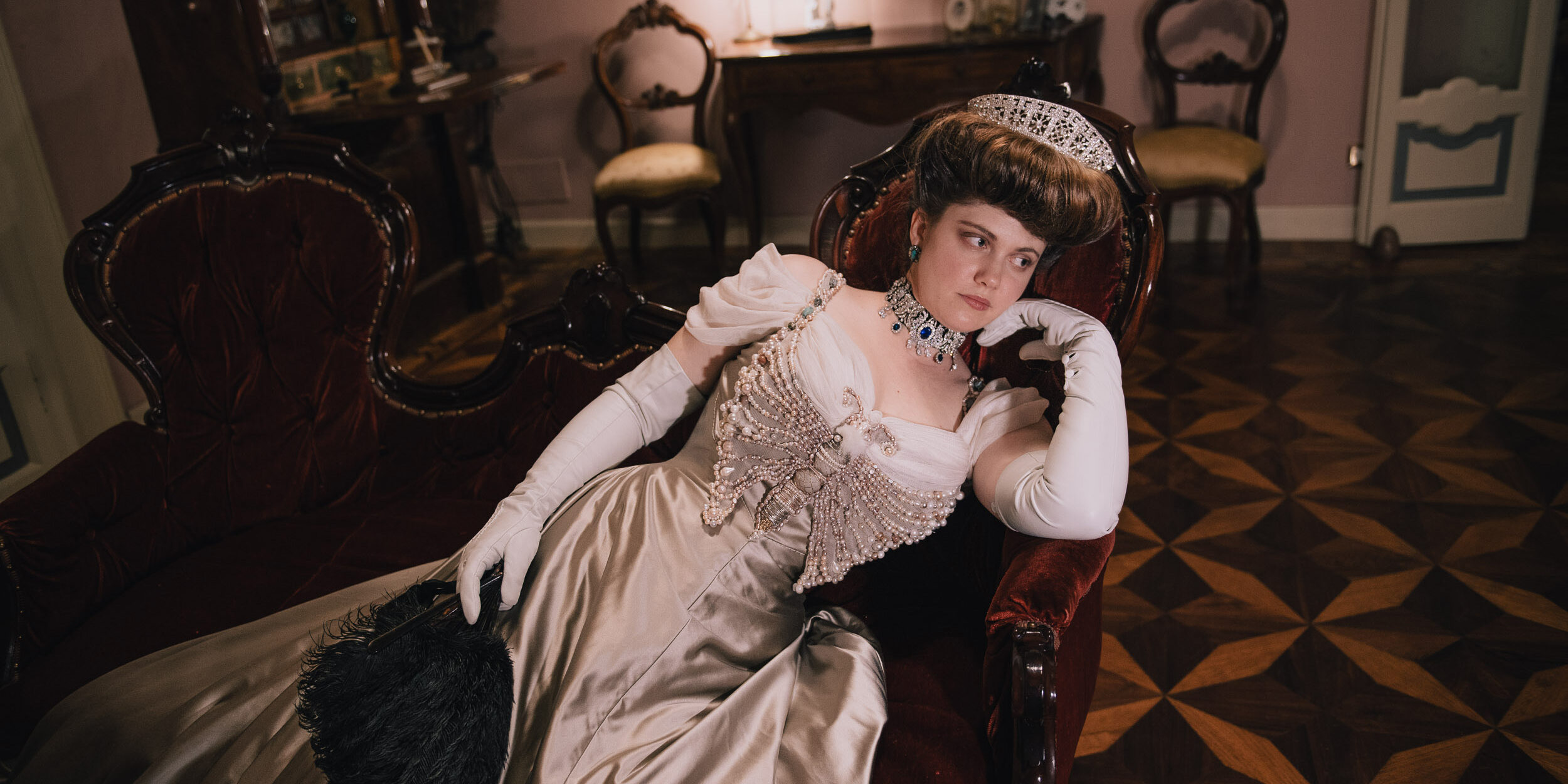
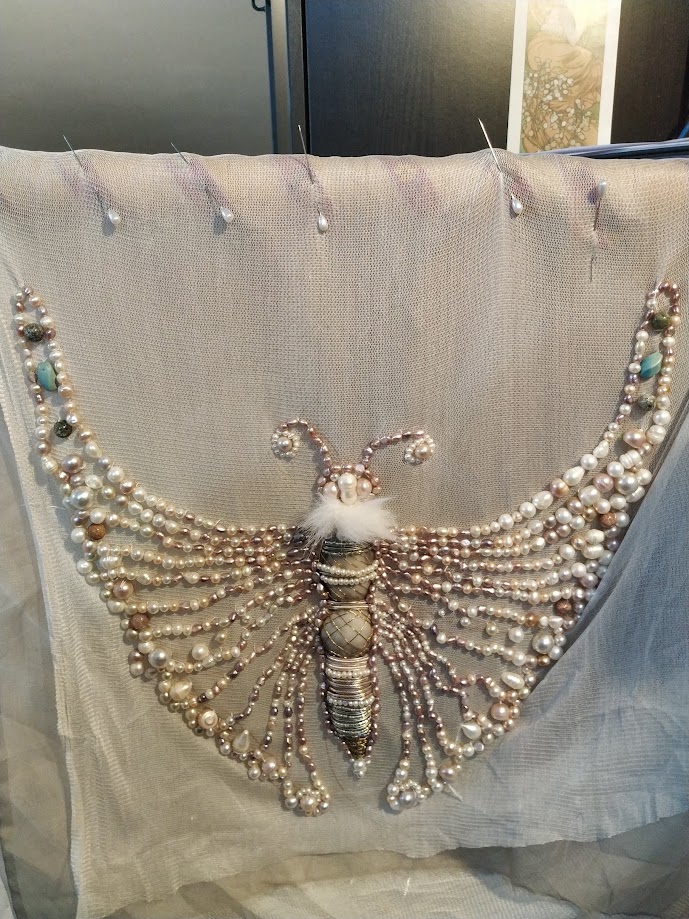
I started sourcing the rest of the materials. I used a mix of freshwater pearls, plastic and glass ones. Using mostly my stash. The butterfly itself is very heavy. The satin as well, so overall the dress is not a light piece. Luckily, it is cut so that the weight is distributed over the corset, so I only feel it when putting it on.
To support the pearls, I overlaid with silk tulle two layers of beige silk organza. I then eyeballed the pattern and stretched the fabrics over my embroidery frame. It started as a de-stressing project, something to do those twenty minutes when you unplug from customer work and ease in the more relaxed things for yourself, before leaving costume work behind. I had more discipline on that, back then. And I ended it much faster than I expected.
I did some alterations on the original design, to adapt it to my frame and the stash supplies I had.
Corset
The dress is shaped to be worn over a corset and two petticoats: a cotton one for structure and a decorative silk blend one, that shows when I lift the skirt to climb the stairs.
As already mentioned, the corset helps distribute the weight of the whole skirt.
For those who are new here, the secret behind the proportions of this outfit is a bespoke corset. Something made from a pattern drafter for my unique body, and fitted to it with a mock-up. It is a time-demanding endeavour to make one, but a nice piece of corsetry serves a whole wardrobe.
If you’re interested in having something that does this for you, I do offer to make similar pieces. HERE is where you can see how it works.
No, there’s no padding. The corset is very light, almost sheer against the light, one layer only. And it’s rich and pretty.


One of the things I was told in the comments was that “back in the days” the corset bottom line would not have shown through the skirt. The person even insisted.
Well, the thing is, you can’t see the corset line there. You really can’t.
- Because the corset is cut much lower, so if any line was visible from its edge, it would not have been there;
- I am wearing two petticoats on top of the corset. They are worn slightly below the waist. One in cotton, one in a silk blend. So, even if I made the corset edge with a 0,5mm cord, you would not be able to detect it, even with the thinnest satin;
- The whole dress is lined in light cotton canvas, which adds one more layer.
So… the line the clever person tried to criticize was… the line where the fabric bends when I sit and walk. The natural line created on natural fibres (viscose is not natural, but it creases like silk) when a piece is worn like… a real piece of clothing, and not a steamed museum piece.
The fabric itself creases like crazy, but silk duchesse would have not improved under that aspect. And the skirt is cut to be flat when you stand. When you move… it moves.
Patterns
But before pointing out how wrong this person was and probably highlighting even more how much that pisses me off, I was writing about the dress construction.
I was asked what pattern I used, many times, for this piece. If you follow my work, you know it: I do not use commercial patterns, I don’t believe in them, all of my work is self drafted, even for my customers. There is the exception of two corset patterns I purchased from Atelier Sylphe, to study the antique corsets in her collection and actually see how they worked. And a pattern in the antique magazine Die Gracieuse, for my 1878 corset. But besides that, I draft every single thing. It’s one of the things that makes my costume look as nice as they do on the person they’ve been made for. And it’s among the reasons why I don’t produce commerciable patterns.
I mainly draped the pearl butterfly Edwardian dress, using a dressing form I had altered to have my proportions. I had carved the polystyrene out in excess at the waist and bust, and filled it with rubber foam. That allowed me to shape the bust and torso with the real corset I would have been wearing underneath the final piece.
The original dress has probably a full circle skirt, cut in four sections. It was made from a narrower fabric, so it has piecing on the skirt, that I avoided replicating.
Things got a bit harder when it came to rising above the waist, as the original piece was made for someone with a less prominent hourglass shape. There, under the embroidered butterfly, I did get a bit creative with the cut, to accommodate my figure and keep the seams of the original dress.

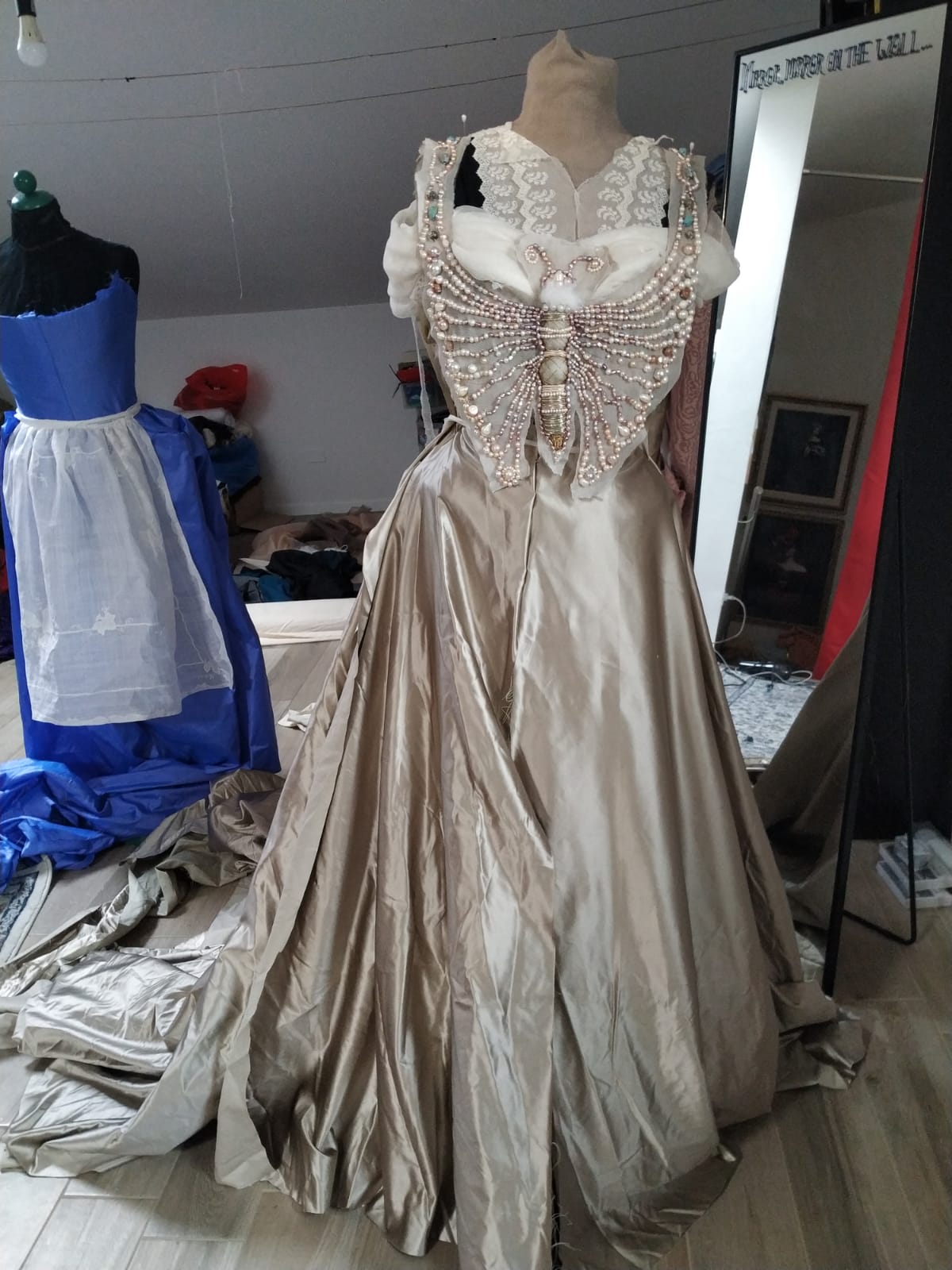
The abundance of fabric at the back of the bodice is present in the original as well, and I replicated it by pinning and hand sewing the back. The closure is at the centre back and is concealed by the draping of the tulle, which I hope one day to replace with a lighter and crispier material. I am still looking and hoping. Again, I was commented that that made the work “not very believable”. I wish I could reply as rudely, seriously.
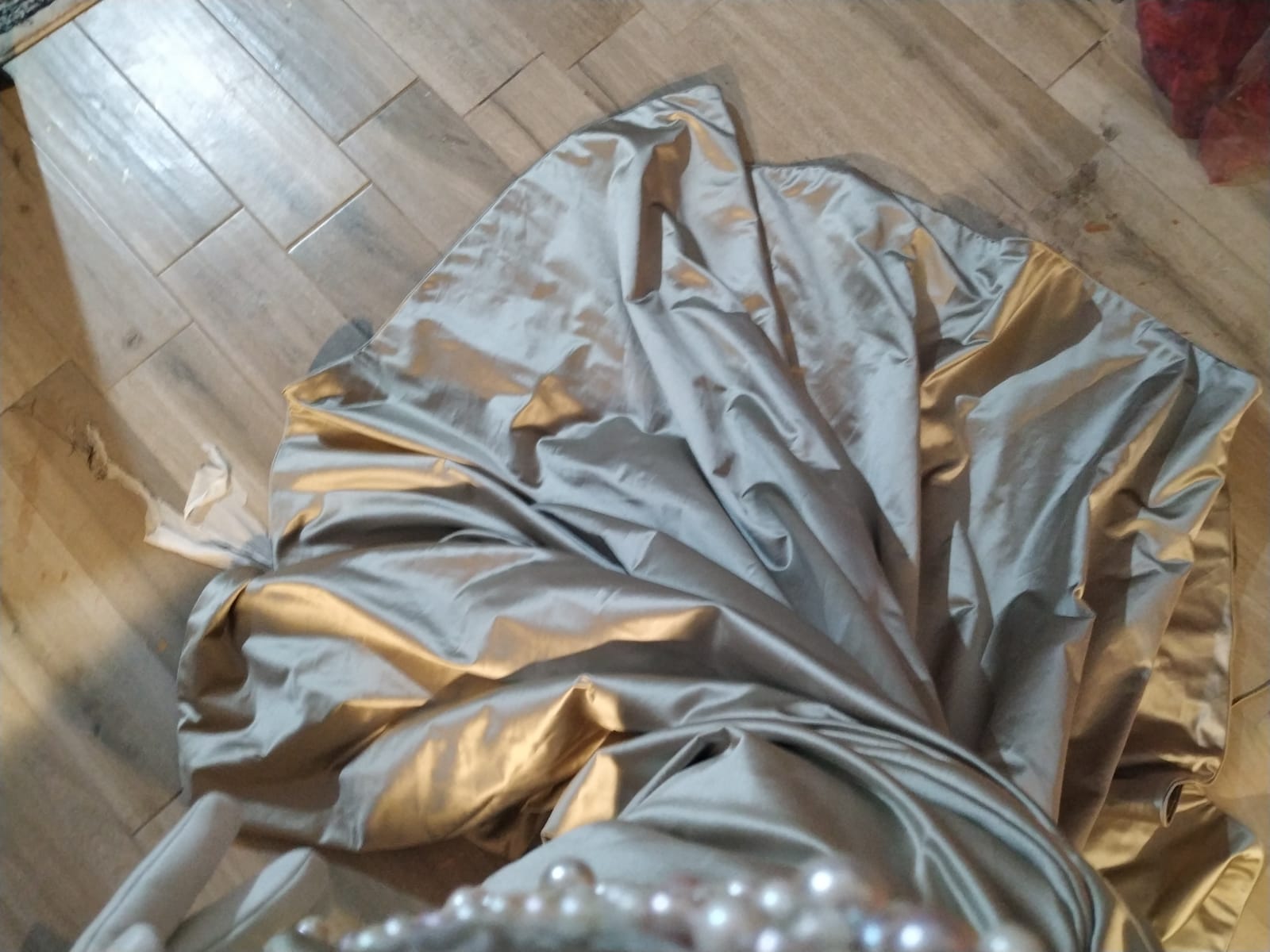
The hem of the pearl butterfly edwardian dress’s skirt in the original one ripples in waves. They are likely caused by how the dress was exposed in the long term and by the weight of the fabric. Long story short: the parts on the bias tend to “give”. Meaning that when fabric warp and weft are at 45° with gravity, that crossing is pulled down and the angle altered. It is why you hang circle skirts with weights before hemming them. I did, in this case, leave my dress to hang for two days, in order to minimize this. The original dress probably did not have it, when it was made. But it has now, after being on a mannequin maybe for longer than it would have liked.
I reinforced my hem with historical techniques: a band of tarlatan and a satin-covered cord. These were usual techniques in dresses of the time, even though the cord was usually folded under the hem, in order to conceal it. The tarlatan sometimes was left free at the top, some others it was stitched down. I think my dress would have liked some with heavier seizing, but the original one as well, so I have postponed re-hemming with a double layer of it, as much as possible.
There has been lots of talk about the train, and how it “swipes” the floor. Many comments educated other commenters about the dust ruffles sewn inside the dresses. However not all evening dresses of the time had them. Especially those which had a full circle skirt. I have reason to believe the inspiration piece for my Pearl Butterfly edwardian dress has none, but again, I have not been granted access to other material than that you can find on pinterest. With all the questions about reliability of the contained information.
The original skirt also seems not to be a regular circle. Nor a narrowed one to make the train swipe backwards. It also opens at the sides,with excess fabric and length. Which looks a bit weird when I twirl in instagram reels, but it does look like the inspiration, especially the folds created at the sides of where the legs of the mannequin would be. That is how that shape moves without real legs and two petticoats underneath.
The pearl butterfly Edwardian dress closes at the back, with concealed hooks and eyes.

I was also told I needed a fan, a shawl and something to hold the train while dancing.
Hold me, please. I did have a fan, an ostrich one, in black. You don’t need a fan, you can choose to have it. Same for the tiara. A shawl then? For a formal evening dress? For an informal garden dinner, maybe. For this dress I have my lovely opera coat, to face the chill of winter outdoors while reaching the venue, but really… Why would I need a shawl, indoors? I am always astonished by how prude nowadays people think people were back then. They were not. Especially in turn of the century Paris. The ankles thing was for the UK and US.
Anyway… last thing to debunk, because what was commented later I don’t wish to read: that I need a string to hold my train. Figure me spitting my tea mid-sip, in my hoodie and sweatpants. That’s a movies thing, in most cases. Good luck in finding a Tissot painting (from the 1870s, when trains were so cumbersome that ladies looked like giant snails) of ladies dancing while holding their train up. Petticoats, tarlatan and dust ruffles are there to help you with the train. When you build such dresses correctly, the back of the skirt just moves around you when you turn. And people (yes, men too) were trained in dance, in places where such dresses were worn, and could easily avoid stepping on. Moreover this shape of skirt would need three wrist loops to gather such a wide train. Have you ever seen such a thing? Because I have not. And I am someone who can spend a whole afternoon trying to find hidden weights in a period dress.
The only right comment about something that should have been done differently, was one left by a person who knows what he was commenting about, and it was about using suspenders over a princess slip. And I replied with the truth: I am my own maid. I do the cleaning, the pressing, the mending of these dresses. And I completely forgot the evening chemise had to be washed and was sitting in my delicates laundry pile. So I used one I had commissioned from a friend of mine, that was ready to be used the day we were filming the promotional videos for the Reverie event. Given the theme of the event, Cocottes, and the flirty aesthetic we were going for, I didn’t want to leave the suspenders floating in the air. Which I did for another video. Where someone else observed that there was no point to having suspenders floating. While I do have a quite large period wardrobe nowadays, I don’t live in period clothing, so I don’t need multiples for my undergarments. One per shape.
The hair
This I get asked a lot as well. And complimented upon. Which is always nice.
I have to start by saying that what you see is mostly my natural hair (on the outside) and that it normally is obnoxiously straight and thin. It is not super long. When I did the videos in question, it was an inch short from my bra hooks.
How I do it?
Well, first of all, practice.
Then it needs a dry environment. In this case… It had rained all day. Poured. Cats and dogs. So my attempt at making the curls I wanted, got annulled. I did curl my hair. I used mousse and hairspray, the one drag queens use. I waited for the curls to be completely dry and cold before opening them. It was no use. The strands kept a few curls at the ends, but the roots were super flat.
I have a crescent shaped net pillow, which I anchor beside the ears, with bobbypins. It is a piece of wire, with looped ends, which I enveloped in the thing used to make hair buns. Lots of it. Until I got the crescent shape.
I then brushed some hair extensions on top. I usually part my hair where a headband would fall. With the rest, I do a french twist. The ends, instead of tucking them in, I arrange at the top of the hair in tidy curls. I then anchor the crescent, brush my own front hair on top of it, arrange the ends in curls to meet the others, and add a couple of hairpieces I have arranged in rolls.
When the waves come out at the roots as well, I try to brush the hair so that I get some sort of wavy look at the front. And I shape the crescent by bending the inner wire, so that it has the proper Pompadour shape and does not look like a weird kokoshnik.
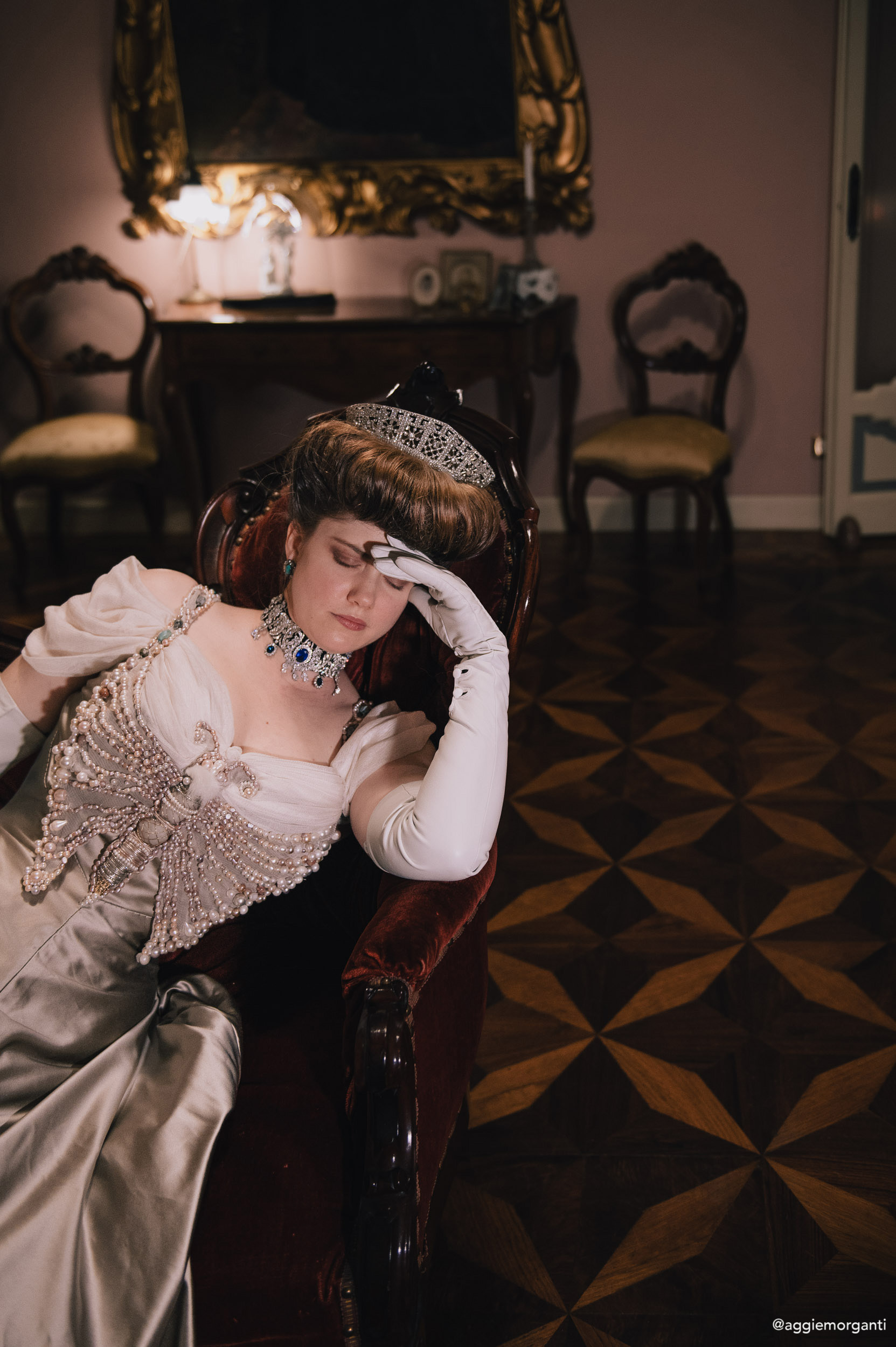
The jewels
This is something I also get asked a lot. And I usually avoid replying because I am not proud of how they are sourced.
For some time I also thought about creating my own selection of the more believable ones and reselling them. But too much time and too little revenue, to keep the prices where they’d deserve to be for something this cheap. But it’s time to explain.
I get most of my bling from Aliexpress. I have tried to purchase the same models from other sources, but all of them were reselling the Aliexpress stuff, five times the original price. I felt scammed and went to the source.
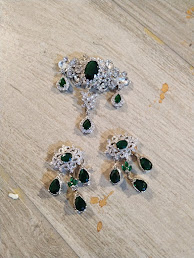
Though the quality is not reliable for all sellers, and size in the pictures is not reliable either, they offer several replicas of period-accurate jewelry, at affordable prices. You really have to look at the reviews, and you have to be able to recognize the replicas from the rubbish. It needs a good eye, and you need to have studied the originals, at least a bit.
Sometimes I take the pieces with clear stones and paint them over into sapphires, rubies or whatever I like with either transparent nail polish colors, or alcohol markers. I like the second ones better, because with just a drop of cleaning alcohol you get a blank canvas, and you have more shades to pick from. But for darker shades, you may want the nail polish.
Sometimes I take brooches and necklaces and tiaras and disassemble them, to use as pieces or to assemble and solder into something only I have. Sometimes I add wires and chenille bases to lift tiaras like the antique ones, so they manage to get on top of the pompadour. I do a lot of different things to get closer to the originals, on a budget.
I am very glad to know I sometimes can achieve a convincing look with these. Unfortunately the budget remains that of a mortal.
I would like however to point out where I get my art nouveau jewels, because they’re from a very skilled artisan you can find HERE. I did not feature them in this look, because I needed to look covered in sparkles like a real diamond-eater courtesan of the time, for this event.
Conclusions
I feared I would have had little to say, and to remember, on a piece I made just before covid started. And here we are: too many pages for my sanity. But I am happy I put this down in writing. Especially the frustration of dealing with some people on facebook. Sometimes I feel people should just ask politely, instead of assuming, and climbing on top of the pedestal to teach others about something they have not made and they can not know how it works.
I know I am the first one to lack the patience to reply politely. But still… Some days picking politeness is harder than I can handle. Sometimes I deserve not to keep everything inside, just to allow others to pretend I’m the lady in the video.
I am, sometimes. But mostly I am a hoodie monster with the ferocity of a hurricane behind a sweet-looking face. And there’s nothing wrong with that.
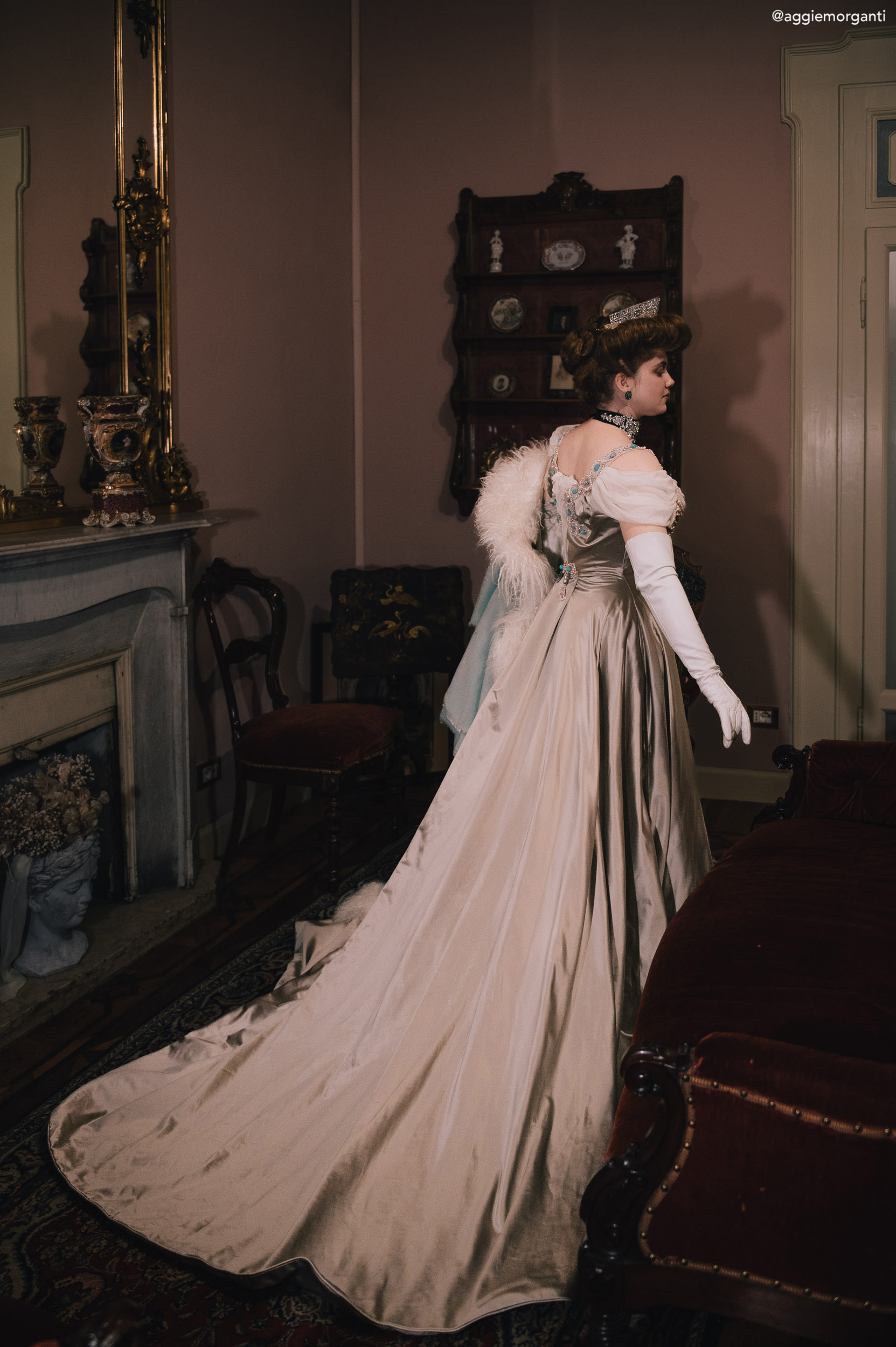
Professional images taken by Agnese Morganti in Palazzo Facchi, during Reverie’s Accademia Spiritica event
The princess slip and the opera coat are by Dario Princiotta.